| --- |
| license: apache-2.0 |
| tags: |
| - image-classification |
| - vision |
| datasets: |
| - imagenet |
| - imagenet-1k |
| --- |
| |
| # Data2Vec-Vision (base-sized model, fine-tuned on ImageNet-1k) |
|
|
| BEiT model pre-trained in a self-supervised fashion and fine-tuned on ImageNet-1k (1,2 million images, 1000 classes) at resolution 224x224. It was introduced in the paper [data2vec: A General Framework for Self-supervised Learning in Speech, Vision and Language](https://arxiv.org/abs/2202.03555) by Alexei Baevski, Wei-Ning Hsu, Qiantong Xu, Arun Babu, Jiatao Gu, Michael Auli and first released in [this repository](https://github.com/facebookresearch/data2vec_vision/tree/main/beit). |
|
|
| Disclaimer: The team releasing Facebook team did not write a model card for this model so this model card has been written by the Hugging Face team. |
|
|
| ## Pre-Training method |
|
|
| 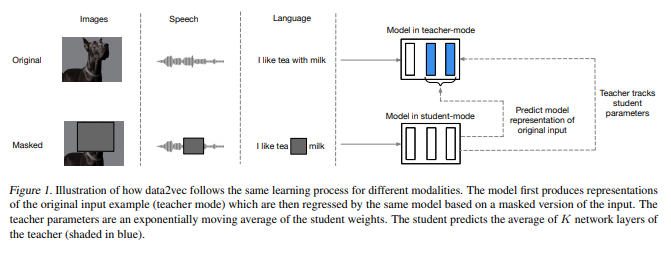 |
|
|
| For more information, please take a look at the [official paper](https://arxiv.org/abs/2202.03555). |
|
|
| ## Abstract |
|
|
| *While the general idea of self-supervised learning is identical across modalities, the actual algorithms and objectives differ widely because |
| they were developed with a single modality in |
| mind. To get us closer to general self-supervised |
| learning, we present data2vec, a framework that |
| uses the same learning method for either speech, |
| NLP or computer vision. The core idea is to predict latent representations of the full input data |
| based on a masked view of the input in a selfdistillation setup using a standard Transformer architecture. Instead of predicting modality-specific |
| targets such as words, visual tokens or units of |
| human speech which are local in nature, data2vec |
| predicts contextualized latent representations that |
| contain information from the entire input. Experiments on the major benchmarks of speech |
| recognition, image classification, and natural language understanding demonstrate a new state of |
| the art or competitive performance to predominant approaches.* |
|
|
| ## Intended uses & limitations |
|
|
| You can use the raw model for image classification. See the [model hub](https://huggingface.co/models?search=data2vec-vision) to look for |
| fine-tuned versions on a task that interests you. |
|
|
| ### How to use |
|
|
| Here is how to use this model to classify an image of the COCO 2017 dataset into one of the 1,000 ImageNet classes: |
|
|
| ```python |
| from transformers import BeitFeatureExtractor, Data2VecVisionForImageClassification |
| from PIL import Image |
| import requests |
| url = 'http://images.cocodataset.org/val2017/000000039769.jpg' |
| image = Image.open(requests.get(url, stream=True).raw) |
| feature_extractor = BeitFeatureExtractor.from_pretrained('facebook/data2vec-vision-base-ft1k') |
| model = Data2VecVisionForImageClassification.from_pretrained('facebook/data2vec-vision-base-ft1k') |
| inputs = feature_extractor(images=image, return_tensors="pt") |
| outputs = model(**inputs) |
| logits = outputs.logits |
| # model predicts one of the 1000 ImageNet classes |
| predicted_class_idx = logits.argmax(-1).item() |
| print("Predicted class:", model.config.id2label[predicted_class_idx]) |
| ``` |
|
|
| Currently, both the feature extractor and model support PyTorch. |
|
|
| ## Training data |
|
|
| The BEiT model was pretrained and fine-tuned on [ImageNet-1k](http://www.image-net.org/), a dataset consisting of 1,2 million images and 1k classes. |
|
|
| ## Training procedure |
|
|
| ### Preprocessing |
|
|
| The exact details of preprocessing of images during training/validation can be found [here](https://github.com/microsoft/unilm/blob/master/beit/datasets.py). |
|
|
| Images are resized/rescaled to the same resolution (224x224) and normalized across the RGB channels with mean (0.5, 0.5, 0.5) and standard deviation (0.5, 0.5, 0.5). |
|
|
| ### Pretraining |
|
|
| For all pre-training related hyperparameters, we refer to the [original paper](https://arxiv.org/abs/2106.08254) and the [original codebase](https://github.com/facebookresearch/data2vec_vision/tree/main/beit) |
|
|
| ## Evaluation results |
|
|
| For evaluation results on several image classification benchmarks, we refer to tables 1 of the original paper. Note that for fine-tuning, the best results are obtained with a higher resolution. Of course, increasing the model size will result in better performance. |
|
|
| We evaluated the model on `ImageNet1K` and got top-1 accuracy = **83.97** while in the original paper it was reported top-1 accuracy = 84.2. |
| If you want to reproduce our evaluation process you can use [This Colab Notebook](https://colab.research.google.com/drive/1Tse8Rfv-QhapMEMzauxUqnAQyXUgnTLK?usp=sharing) |
|
|
| ### BibTeX entry and citation info |
|
|
| ```bibtex |
| @misc{https://doi.org/10.48550/arxiv.2202.03555, |
| doi = {10.48550/ARXIV.2202.03555}, |
| url = {https://arxiv.org/abs/2202.03555}, |
| author = {Baevski, Alexei and Hsu, Wei-Ning and Xu, Qiantong and Babu, Arun and Gu, Jiatao and Auli, Michael}, |
| keywords = {Machine Learning (cs.LG), FOS: Computer and information sciences, FOS: Computer and information sciences}, |
| title = {data2vec: A General Framework for Self-supervised Learning in Speech, Vision and Language}, |
| publisher = {arXiv}, |
| year = {2022}, |
| copyright = {arXiv.org perpetual, non-exclusive license} |
| } |
| ``` |


